
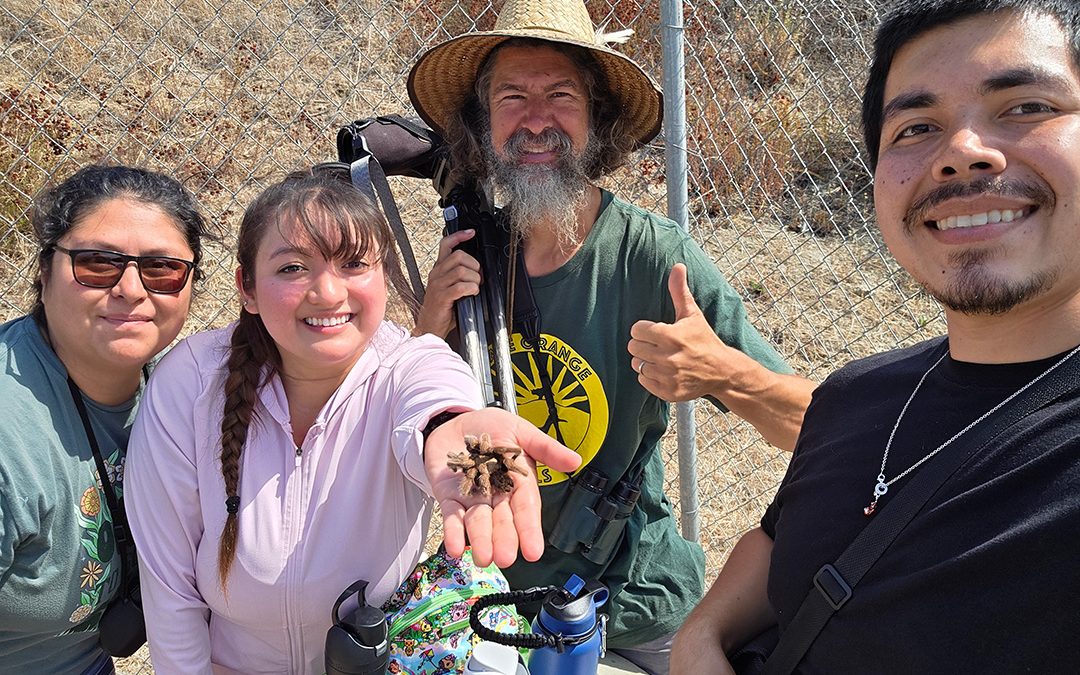
Every week during this fall season, please consider joining our team of volunteers and interns for our biological surveys around the perimeter of the proposed Orange Hills Regional Park. This is a fun and educational opportunity to be a citizen scientist and record observations of special status wildlife and plant species that occur on the incredibly diverse 400-acre wildlife corridor. With binoculars, a spotting scope, field guides, and the iNaturalist and Merlin apps, we’re able to identify species and add them to the Save Orange Hills iNaturalist project, eBird, the California Natural Diversity Database (CNDDB), and the Roadkill Observation System (CROS).
On Wednesday, November 18, Mike, Scott, and Joel saw a male northern harrier (Circus hudsonius) flying low over the grassland and scrub near the intersection of Jamboree Rd and Santiago Canyon Rd. Males are gray above and whitish below with black wingtips, a dark trailing edge to the wing, and a black-banded tail. Females and immatures are brown, with black bands on the tail. A female northern harrier was seen during past surveys. Northern harriers are uniquely known for hovering over their prey and nesting on the ground. They are declining throughout their range and are classified as a California Species of Special Concern. Habitat loss due to development, and reduced nesting and foraging opportunities, has been a major factor for the species’ population decline. Northern harriers are also susceptible to pesticide exposure from consuming pesticide residue found in the tissue of small mammals, their primary source of prey.
A dead yellow-faced bumblebee (Bombus vosnesenskii) was found along the bike lane of Santiago Canyon Road. Studies have demonstrated that paved environments in human urban settings have reduced B. vosnesenskii nesting densities. It is likely that this is due to the subterranean nesting habits of this bee species, which is negatively affected by the expansion of impervious surfaces like pavement.
On Friday, November 6, Mike, Caroline, Ian, and Joel tested bat detectors that were generously loaned to us by Stephanie Remington, Orange County’s bat biologist. We recorded the ultrasonic frequencies of multiple bat species! We are currently analyzing the call files with the assistance of Stephanie to determine what species we heard. At this time of year, we have a chance to find migratory bats, including hoary bats (Lasiurus cinereus), western yellow bats (Lasiurus xanthinus), and western red bats (Lasiurus frantzii), which roost in trees. Both the western yellow and red bats are considered vulnerable California Species of Special Concern.
Recent rains have increased chances of observing amphibians, including California toads (Anaxyrus boreas halophilus), Pacific chorus frogs (Pseudacris regilla), and western spadefoots (Spea hammondii), which are proposed to be listed as threatened under the Endangered Species Act (ESA). California toad tracks were observed on the Horseshoe Loop Trail near the Puma Ridge Trail intersection in Irvine Regional Park.
San Diego wirelettuce (Stephanomeria diegensis), cliff aster (Malcothrix saxatilis), telegraphweed (Heterotheca grandiflora), and coastal goldenbush (Isocoma menziesii) are blooming. Wild hyacinth/Blue Dicks (Dipterostemon capitatus) and lupine (Lupinus sp.) are already emerging! Dormant perennial shrubs, including California brittlebush (Encelia californica) and California sagebrush (Artemisia californica), are awakening with lush new foliage. Some of our southernmost natural occurrences of purple sage (Salvia leucophylla) are visible along the south side of Santiago Canyon Rd as you head east from Jamboree Rd towards the 241/261 toll road.
All recorded biological data will help us to submit in-depth comments on the draft environmental impact anticipated to be released in Spring of 2027, so please join us for an upcoming survey and help us document special status species that rely on the Orange Hills for their survival.
Biosurveys are on Wednesday mornings at 8 am and Fridays at 4:30 pm. For weekend biosurveys, contact Joel Robinson to determine dates and times. Once you are trained, we hope you’ll consider scheduling your own biosurveys with family, friends, and co-workers on a weekly or monthly basis.