
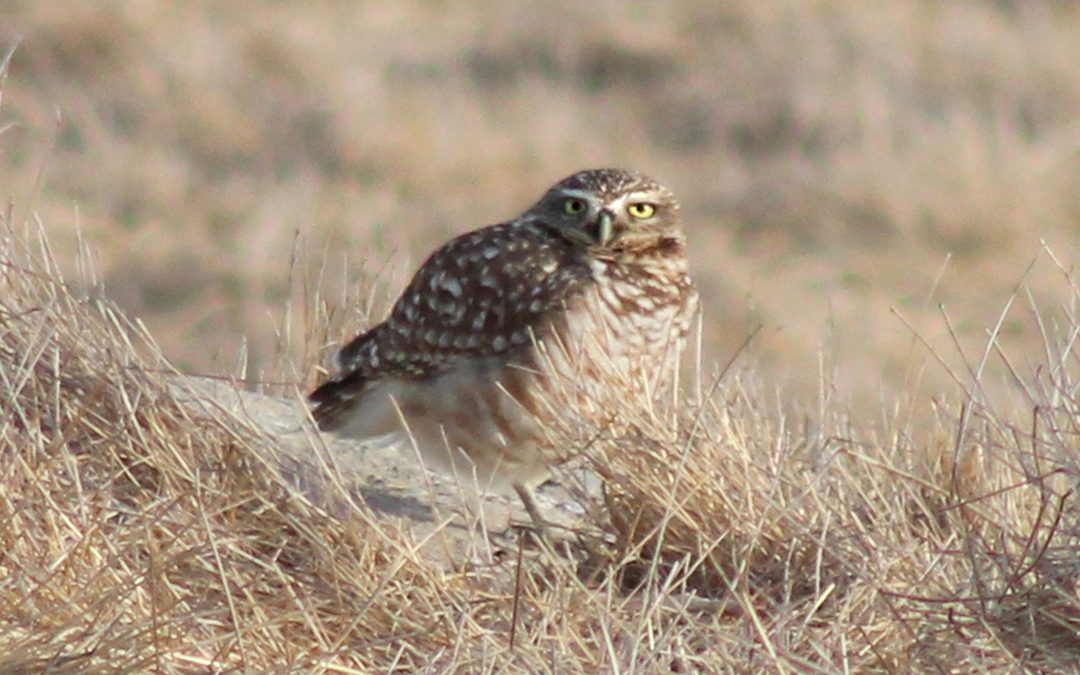
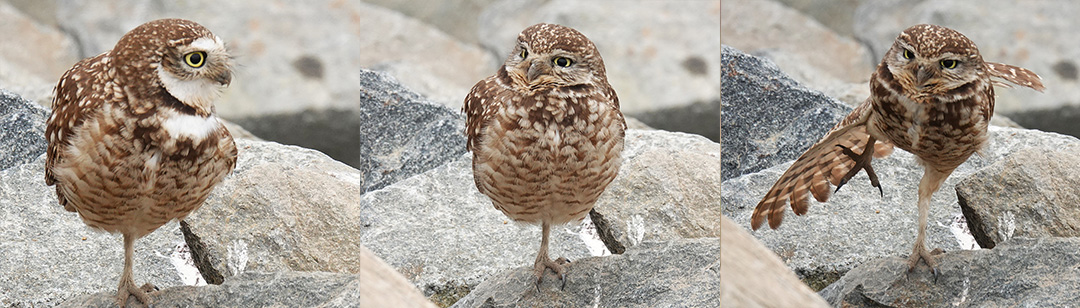
The western burrowing owl (Athene cunicularia hypugaea) is a small ground-dwelling owl – about 7-11 inches (19-28 cm) long, weighing about 5-8 ounces (140-240 g), with a wingspan of about 20-24 inches (50.8-61 cm) across. The male and female are about the same size. The female tends to be heavier, and the male is usually lighter in color and has longer linear measurements. They have long naked legs that enable them to sprint when pursuing prey. In addition, their long legs provide momentum when taking flight. Their low undulating flight is usually close to the ground and short in duration. They also hover like a kestrel.
They are a light chocolate brown with a mixture of bars and spots and a short sandy brown tail with white marks. They have a round head, a flat facial disc, and a prominent white V-shaped band over their yellow eyes. They lack ear tufts and have a white “chin” patch that expands during certain behaviors. Juvenile birds have plain brown upperparts with little to no distinct markings, a dark brown chest, and pale buff underparts.
Burrowing owls are often seen standing near their nest burrow entrance on a small mound of dirt. They are active during the day and hunt insects, small mammals, and birds primarily during twilight hours. They require areas of short vegetation in which to hunt. When there are young in the nest burrow, they feed day and night. They will often store large amounts of food for incubation and brooding periods. They can be seen on low fence posts during the day and night, surveying their surroundings. Often seen making quick bobbing and bending motions that help them to gain depth perception. Because this behavior makes it look like they are saying “hello,” they are also called the “Howdy Owl.”
Burrowing owls’ nests can be found in a variety of settings: grasslands, shrubland, deserts, and rangelands make up natural settings, and human-altered landscapes include agricultural areas, golf courses, airports, schools, and parks. Despite their common name, they do not usually construct these dwellings themselves. Instead, they repurpose disused burrows or tunnels previously created and inhabited by other species such as ground squirrels, badgers, foxes, or prairie dogs. It is lined with materials at hand, from cow manure to their own feathers. Researchers believe that the manure helps to control the microclimate inside the burrow and to attract insects, which the owls may eat. The burrow extends downward at an angle and can be from four to eight feet in length, with an enlarged nest cavity at the end. They nest singly or in small colonies. A clutch contains 4-12 white eggs (5-6 are common). The female incubates the eggs for 3-4 weeks. The male brings her food. Both parents feed the chicks. Approximately four weeks after hatching, the chicks begin to explore their environment outside the nest burrow and make short flights. The parents and chicks stay together as a family for several more months. Mid-summer marks the end of nesting. There is only one brood raised in a year.
The sounds of the burrowing owl range from shaky chuckles and coos to soft cooing sounds at night to a dry rasping rattle quite like the sound of a threatening rattlesnake when disturbed. This species can live for up to 11 years in the wild and up to xx years in captivity. They have many natural enemies, including coyotes, badgers, and snakes. They are also killed by vehicles when crossing the road and by both feral and domestic dogs and cats
For an owl, being a ground-dweller makes them unique, but it also makes them more vulnerable. This species was once found in abundance across California in flat coastal lowlands, interior deserts, and wide lowland valley bottoms. Their numbers have declined due to suburban and urban development, farming and ground squirrel control, pesticide poisoning, and predation. It is vital that we do everything we can to preserve the ~400-acre area we call Orange Hills for the benefit and survival of the burrowing owl and all of the other species that call this place home.
On March 5, 2024, the Center for Biological Diversity, Defenders of Wildlife, Burrowing Owl Preservation Society, Santa Clara Valley Audubon Society, Urban Bird Foundation, Central Valley Bird Club and the San Bernardino Valley Audubon Society submitted a petition to the California Fish and Game Commission (CFGC) to list the western burrowing owl as a threatened or endangered species under the California Endangered Species Act (CESA). The commission published the findings of its decision to make the species a candidate for listing on October 25, 2024, and as such, the western burrowing owl now receives the same legal protection afforded to an endangered or threatened species (Fish and Game Code sections 2074.2 and 2085). Candidate status for listing under the CESA gives the burrowing owl temporary protection while the CFGC carries out a comprehensive review. We will keep you updated on the status of the burrowing owl.
Photos from Julia Markey (owl with grass background) and Rita Robinson (owl with rock background)